Anthropic Files S-1 Giving Enterprise AI Buyers Leverage
Anthropic's S-1 filing reveals the company's need to fill its compute capacity, giving enterprise AI buyers leverage to negotiate better prices and terms. This shift in power may lead to cheaper AI services.
Original reporting · forrester.com
Original: “Anthropic’s S-1 Hands Enterprise AI Buyers Better Leverage”
Read “Anthropic’s S-1 Hands Enterprise AI Buyers Better Leverage” at Forrester →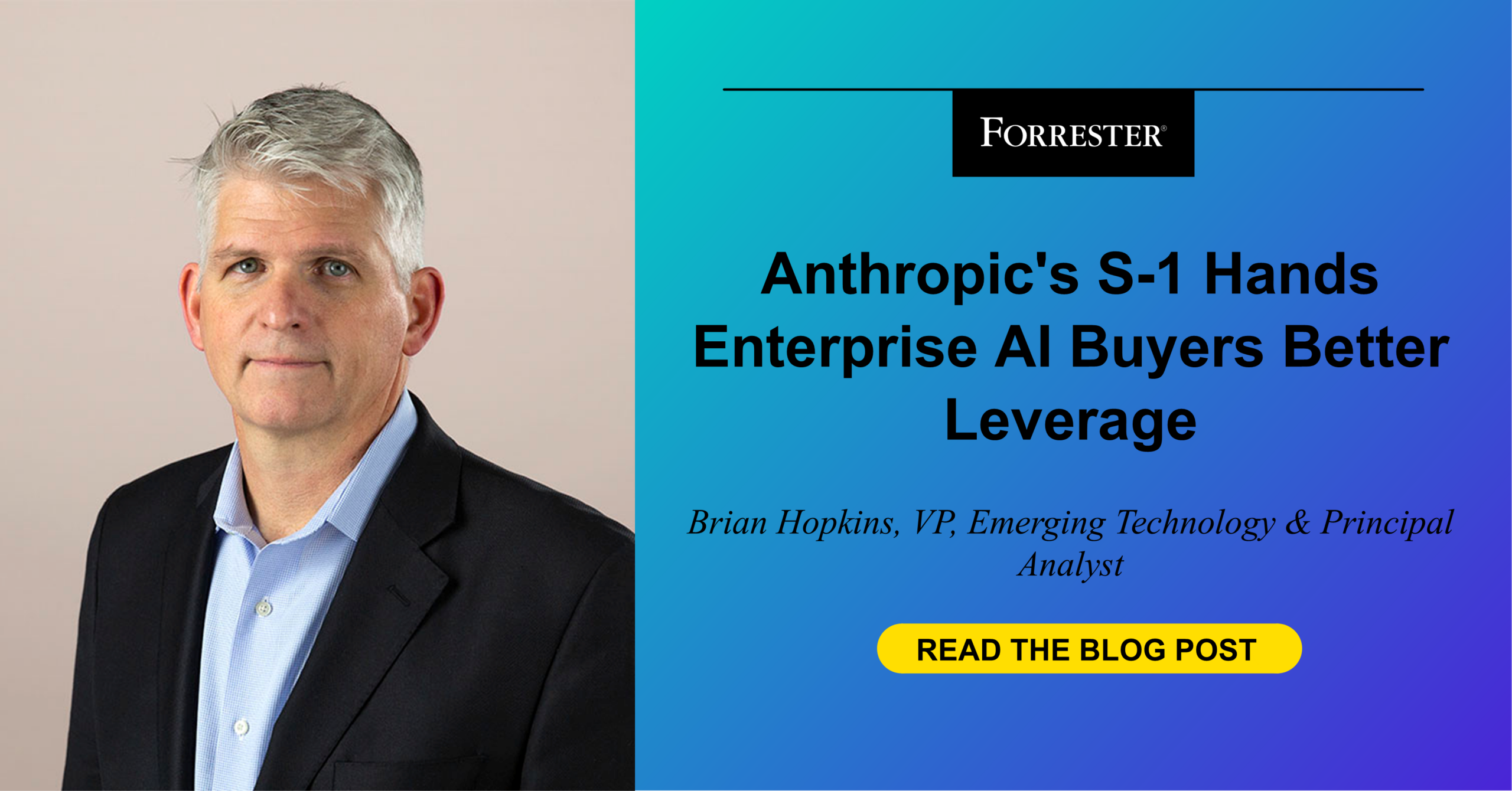
How this was written. Awesome B2B wrote this article with a language model from Forrester’s reporting (model: @cf/meta/llama-3.3-70b-instruct-fp8-fast); it describes that reporting rather than adding to it. The original, linked above, is the full story.
Key points from Forrester’s report
- Anthropic's S-1 filing reveals the company's need to fill its compute capacity, giving enterprise AI buyers leverage to negotiate better prices and terms.
- The company's gross margin was 85% in the first half of 2026, up from 12% a year before, indicating significant revenue generation from its AI services.
- Public investors will have less say in the company's decisions, as one founder's share holds 50.1% of the vote, and a trust elects most of the board.
- Enterprise buyers should negotiate shorter contracts, watch usage limits closely, and plan for fast model turnover to get the best deal.
- Buyers should also be aware of their cloud providers' stake in their Claude bill and consider benchmarking alternatives themselves.
Anthropic's recent S-1 filing, according to Forrester, shows that the company's pricing may get cheaper due to its need to fill its compute capacity. The filing reveals that Anthropic has committed to paying suppliers $265.6 billion, while customers have only contractually committed to pay $10.8 billion. This disparity gives enterprise buyers leverage to negotiate better prices and terms.
The company's gross margin was 85% in the first half of 2026, up from 12% a year before, indicating that it has been generating significant revenue from its AI services. However, the newest model has cut customers' cost per task by about 40%, and the company needs to keep prices low to fill its compute capacity.
Anthropic's research priorities will not be slowed down to improve its margins, as the company has to keep pushing the frontier to generate revenue. The models released in the prior six months brought in more than 80% of third-quarter revenue, making it essential for the company to continue innovating.
Public investors will have less say in the company's decisions, as one founder's share holds 50.1% of the vote, and a trust elects most of the board. This means that the founders and the trust will set pricing and research priorities, giving them significant control over the company's direction.
Enterprise buyers can use this information to their advantage by negotiating shorter contracts, watching usage limits closely, and planning for fast model turnover. They can also treat Anthropic as a durable vendor with a long bet, as the company has generated significant operating cash and holds substantial assets.
Additionally, buyers should be aware that their cloud providers have a stake in their Claude bill, as they gain from the spend several times over. This gives them room to negotiate better prices and terms, and buyers should consider benchmarking alternatives themselves to get the best deal.
In conclusion, Anthropic's S-1 filing provides valuable insights for enterprise AI buyers, giving them leverage to negotiate better prices and terms. By understanding the company's needs and priorities, buyers can make informed decisions and get the most out of their AI services.
Questions and answers
What does Anthropic's S-1 filing reveal about the company's pricing?
The filing reveals that Anthropic's pricing may get cheaper due to its need to fill its compute capacity.
How can enterprise buyers use this information to their advantage?
Buyers can negotiate shorter contracts, watch usage limits closely, and plan for fast model turnover to get the best deal.
What is the significance of cloud providers' stake in Claude bills?
Cloud providers gain from the spend several times over, giving them room to negotiate better prices and terms.